Showing posts with label paradox. Show all posts

Monday, 14 October 2024

The Unexpected Result of Twisting on the Magic Paving Stones

At the end of Twisting on the Magic Paving Stones, I noted that there was something unexpected.  Please look back over previous articles to see the full details but, in short, what I was discussing is a scenario in which, in each round of a sort of game, a number of magic paving stones (≥2) are inserted at random locations (with an evenly distributed likelihood) into a path, then a monster takes a step from one paving stone to the adjacent one closer to you (starting at one step closer to you than the last paving stone in the path) and then you eliminate one paving stone of your choice (and since you don’t want the monster to get you, you are going to eliminate one behind it, further away from you).

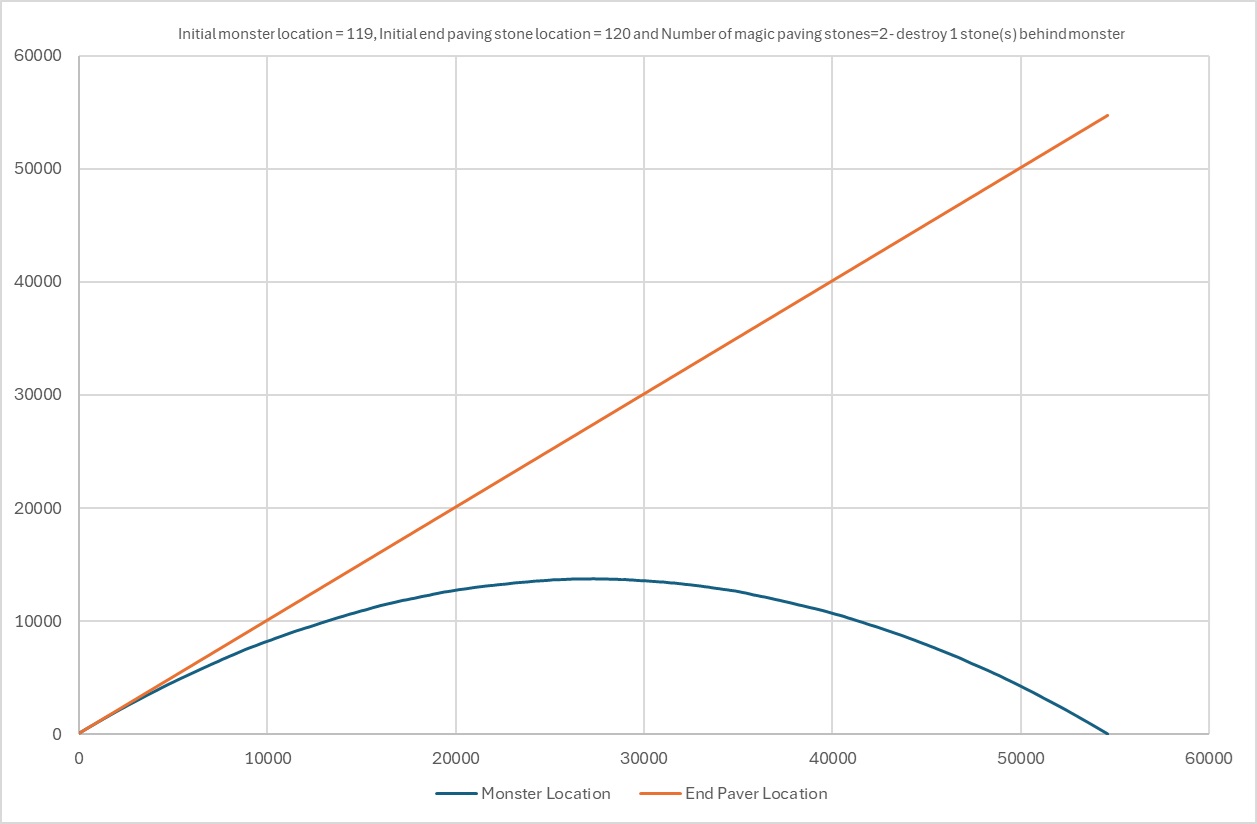
Set the number of randomly inserted paving stones to 2, the initial pathlength to a sufficiently large value (for which I choose 120, so the monster starts on paving stone number 119) and plot the output once every 200 rounds and you get this:

It might not be immediately obvious, but we’ve seen something like this before (or at least those of us who looked at the OE curve).  To emphasise this, here is that monster location curve with the OE curve below it – noting that smoothing has been turned off.

This is rather curious and was in fact something that I was struggling with – having previously posted two articles on the same sort of thing before retracting them (soon to be reinstated at Observable Events Curve - Is Double Dipping Essential? and Observable Events Curve - Not Quite a Drunkard's Walk).

Note that the time (or number of rounds) that is taken for the monster to get you (or “capture time”) is not set, there’s something akin to chaos happening in that the capture time very much depends on slightly different conditions early in the scenario, which – after the first round – are randomly imposed.

The OE Curve line in red above is based on time it takes for the separation to reach zero, t0 (with a relatively insignificant offset to account for the fact that the initial separation is not zero, but rather an offset that we can call xi).  The final equation becomes:

x'=ct((ct0+xi)-ct)/(ct0+xi)

If ct0>>xi and ct=x, this approximates, of course, x'=x(ct0-x)/ct0.

Sunday, 13 October 2024

Twisting on the Magic Paving Stones

In Why the Magic Paving Stones Puzzle is a Paradox I provided the solution to the Magic Paving Stones puzzle. 

What I want to do now is to introduce a slight twist.

Once again, you are standing on one end of a path of paving stones.  At the other end of the path is the monster.

Once again, you have the choice again about how many magic paving stones will appear randomly (as previously defined) along the path every round, prior to the monster taking each step from one paving stone to the next towards you.

However, before things start, you are offered the option to give one free step that the monster can take towards you (so before any magic paving stones are activated) in exchange for the ability to destroy one paving stone of your choice every round, so long as the sum of additional paving stones per round is greater than zero.

I know this is complicated, so I will try to clarify using an illustration.

What choices do you make in this instance?  Can you prevent the monster from getting you?

---

Note that there’s something unexpected involved here, but it’s not actually in the solution to the puzzle.

Saturday, 12 October 2024

Why the Magic Paving Stones Puzzle is a Paradox

The puzzle posed in Magic Paving Stones may or may not be a paradox.  It might come down to expectations and definitions.  If you don’t have any expectations, or you work out the right answer straight away, then there’s no paradox at all.  If there’s a lack of clarity in definitions of key terms, then … well, it’s still a sort of paradox.  Alternatively, it might be one of Quines’ “veridical” paradoxes.

The crux of the puzzle is how many extra steps you must make a monster take in order that it never reaches you.  If you can ensure that there is an extra paving stone inserted between you and the monster for every step it takes then it can never reach you, so the problem then becomes how many extra paving stones across the whole range need to appear (at random, as defined in the puzzle) every time the monster is about to take a step.

It's not 1, as suggested by one respondent (at r/paradoxes).  If only one step is added, then, as soon as the monster takes one step, there is a (possibly very small) chance that any step that appears (by means of an additional paving stone) will be behind it – on the other side from you, allowing the monster to get closer to you and thus increasing the chance that the next paving stone that appears will also be behind it.  That leads, quite quickly, to a situation in which the monster is bearing down on you steadily and remorselessly like the antagonist in “It Follows”, but you can’t run!

It's not 2 either, as I have heard suggested.  This is, I think, a quite intuitive answer – there is one paving stone to counteract the step that the monster is about to take and another to push it further away.  The problem is that there is a vanishingly small, but non-zero chance that both additional paving stones will appear behind the monster (at some time after it has taken its first step) and it therefore gets closer to you.  Again, this will increase the likelihood, in future rounds, that both additional paving stones will appear behind the monster.  Sure, the time taken for the monster get to you increases, but never is very long time (to paraphrase Roxette and the Red Hot Chili Peppers).

The other intuitive option, which only seems to be suggested when I use an actual number of paving stones for the initial path, is to set the number to equal the number of existing paving stones or number of slots available.  So, say I suggested (as an example) that you start off with 12 paving stones, it seems intuitive to some that the answer is either 11 or 12.  I think there is a tendency to think of the slots being filled evenly, but that was not what was specified in the puzzle.  The likelihood of a paving stone going into any specific slot is equally distributed across all slots, which does not prevent multiple paving stones appearing the one slot.  Once the monster has taken one step towards you, there is a possibility that future magic paving stones will appear behind it and eventually it becomes quite likely that all of them will, allowing monster to get closer to you and eventually get you.

I wrote a program to simulate this, allowing me to adjust the total number of rounds, the initial location of the monster, path length and the preset number of magic paving stones.  As an extreme, I set the monster at paving stone 2 of 2, and then set the number of magic paving stones to 12.  Then I charted the output:

Note that this is isn’t always the precise outcome quantitatively, sometimes the number of rounds was at least eight times that, sometimes as little as half of it.  But in every single instance when I ran the numbers, it turned out that – eventually – the monster gets you.

So, the answer to the puzzle appears to be that you need an infinite number of paving stones to appear each round in order to prevent the monster ever getting you.

I don’t think that this is an intuitive answer, nor the answer that most people will expect.  So, in the soft sense at least, I do think that this is a paradox.

--- 

There’s another sense in which this is a paradox – based on the vagueness of the term “never”.  The question was posed like this: what is the minimum number of magic paving stones do you have to preset for activation each round to ensure that the monster never reaches you?

If I had said “ensure that the monster cannot reach you”, then perhaps not even an infinite number of magic paving stones would suffice.  As soon as we start throwing around infinite numbers, we must sure accept also the possibility of an infinite number of rounds – after which the monster does reach you.  The way I think of it is that either the monster gets you, and the game is over, or there’s another round with an infinitesimal likelihood that that monster will get slightly closer to you.  If there’s no end of rounds, then the only way it stops when the monster gets you.

This seems like a weird variation of the Hilbert paradox, which is a veridical paradox, not because it involves set theory, but because it involves a conflict of infinites.

In the first round, you effectively put an infinite number of paving stones between you and the monster. In the second round, you have an infinite number of paving stones that appear across a range that is infinite, but split between single paving stone behind the monster (that it just stepped away from) and the infinite number between you and the monster (noting that it is a slightly larger infinity, since it is the infinite number of new paving stones plus the original number of paving stones – let’s call this infinity+).  There’s a one over infinity+ likelihood that any one of the infinite number of paving stones will appear behind the monster, but there’s the preset and slightly smaller infinite number of them.  The likelihood of any one paving stone appearing behind the monster is infinitesimally small (against what is effectively a 100% chance of appearing between you and the monster, since infinity/(infinity-1)=0.99999…=1). But with an infinite number of paving stones appearing – all possibilities no matter how unlikely will surely be expressed. 

Now there are two infinities of paving stones, with some tiny proportion of them being behind the monster.  With each round another infinite number of paving stones appears, each with a slightly greater proportion of them appearing behind the monster, but the monster is still getting further away.  It seems that it is impossible that it will ever reach you.  However, if we use any arbitrarily large number, N, as the number of magic paving stones, we can see that – eventually – the monster does get you.  Adding one, or two, or any other arbitrarily large number to N doesn’t save you and there’s no reason to think that that would ever change and, logically, we could add an arbitrarily large number times an arbitrarily large number and it would make no difference, so neither should adding infinity.  And thus the monster gets you, eventually, even though it seems quite impossible that it should.

---

So, I ask again, is this a known paradox?  Or a variation of a known paradox?  (Or just silliness when you take it to extremes and get infinities involved?)

---

It has been pointed out (by u/crescentpieris) that there is a very similar mathematical puzzle that appears paradoxical, thus falling into the soft paradox category – Ant on a Rubber Rope. I do have one more twist to it though, as per the next article.

Thursday, 10 October 2024

Magic Paving Stones

This is a sort of a puzzle, sort a paradox (in the soft sense of running contrary to expectation, rather than involving explicit self-contradiction).

Imagine you are standing the first paving stone of a path that consists of an arbitrary number of paving stones.  At the end of the path is some vague monster that you don’t ever want to reach you.  As happens in a nightmare, your feet are firmly stuck to the paving stone that you are standing on and you can’t run.  Fortunately, you have two facts in your favour.

Fact one: the monster moves at a rate of one paving stone per round.

Fact two: you have a singular (once-off) choice to preset the number of magic paving stones that will be activated per round – just before the monster moves.  These magic paving stones will appear between existing paving stones, at random.  More specifically, the likelihood of the paving stone appearing between any two existing paving stones is evenly distributed across the whole path.  For example, if there are three paving stones, there are two locations where a new paving stone could appear – between #1 and #2 (slot #1#2) and between #2 and #3 (slot #2#3), with equal likelihood of P=0.5.  Like this:

For even more clarity, each magic paving stone is inserted between existing paving stones with equal and independent likelihood.  So, if the number of magic paving stones per round that you preset is two, and there are three paving stones, then each magic paving stone could appear in either slot #1#2 or slot #2#3, with an independent likelihood of P=0.5.  This would lead to a likelihood distribution of P=0.25 for both to appear in slot #1#2 or both in slot #2#3, and P=0.5 for one each in slots #1#2 and #2#3 (because there are two variants of this outcome as shown below).


The apparently simple question is: what is the minimum number of magic paving stones do you have to preset for activation each round to ensure that the monster never reaches you?

---

Note that your only decision involves the preset number of magic paving stones that appear each round.  You don't place those stones, they just appear.  Once you set the number, that's it, you can't change it.  Since we are after the minimum number, and we are talking about magic paving stones, we could also add that if you choose a number to be the minimum that is wrong, the stones won't activate at all and the monster gets you.

Monday, 31 July 2017

Two Envelopes and the Hypergame

The two envelopes problem goes a little like this:

Say I offer you one of two identical envelopes.  I don't tell you anything other than that they both contain cash, one contains twice as much cash as the other and that you can keep the contents of whichever envelope you eventually choose.  Once you make a choice, I offer you the opportunity to switch.  Should you switch?

Note that there's no need for me to know or to not know what is in each envelope (so this is not a Monty Hall type situation in which my knowledge affects your decision).  Note further that each time you make a choice (including the choice to switch), I could conceivably offer you the opportunity to switch - so if you were to decide to switch, then the same logic that caused you to switch in the first instance still applies and therefore you should take me up on the offer and switch back to the original envelope, and switch again, and again, and again.

To me, this indicates that the only valid answers to the question "should you switch?" go along the lines of "it doesn't really matter if I switch or not because, statistically speaking, there is zero value in a switch, I don't gain or lose anything by switching".

---

So, why might you think that there is value in switching?  A presentation of the problem at Quora put it this way:

Well, think about the expected payoffs here. You had a 50% chance of choosing the better envelope from the start, right? So that means half the time, the second envelope will have twice as much money as the first one, and half the time it'll have half as much. So say the first envelope has $10 in it; then if you switch, you have a 50% chance of losing $5 and a 50% chance of gaining $10. So it's objectively better to switch!

This is one of those rare situations in which using actual numbers can make understanding slightly more difficult, so let's think about this in terms of X.

You choose an envelope and assign that envelope a value of X dollars.  In the other envelope is either 2X dollars or X/2 dollars, each with an equal likelihood.  Therefore, a switch has the following value:

0.5 * (2X-X) + 0.5 * (X/2-X) = 0.5X - 0.25X = 0.25X

So, when thought about this way, there's apparently a positive value associated with the switch rather than a zero value.

This is clearly the wrong way to think about it.  First and foremost, it skews the total value of envelopes.  On one hand, you are presuming that there is $30 in total value and you have the wrong envelope, while on the other, you are presuming that there is only $15 but you have the right envelope.  Naturally, it’s going to look like swapping is better since you currently only have $10 if you are right and stand to gain $10 if you swap, while only rising the loss of $5 if you are wrong.

A better way is to think about this in terms of X and 2X only.  One envelope has X dollars and another has 2X dollars.  Once you have selected an envelope, there is a 50% chance that you have X dollars and a 50% chance that you have 2X dollars, therefore, the value of your envelope is:

0.5 * X + 0.5 * 2X = 1.5X

The value of the other envelope must, given that the total value of both envelopes is 3X, be 1.5X dollars as well and there is therefore zero value in switching.

The value of the switch can also be calculated this way - there is a 50% chance that you will give up X dollars in exchange for 2X dollars and a 50% chance that you will give up 2X dollars in exchange for X dollars:

0.5 * (2X-X) - 0.5 * (X-2X) = 0.5X - 0.5X = 0

So the "paradox" resolves down to a simple misrepresentation of the problem (related to the old error of counting chickens before they hatch).

---

Naturally, there is a slight twist.  Say I give you an envelope (with X dollars in it), then I toss a coin and fill another envelope with an amount of money based on that result.  All you know is that there is a 50% chance that the second envelope has 2X dollars in it and a 50% chance that is has X/2 dollars.  On this basis you should in fact swap, because the second envelope has a value of 1.25X dollars (therefore the value of switching is 0.25X dollars as calculated above).

In this instance, however, it initially seems as if, were I to ask you if you wanted to swap again, you should say no, because the first envelope only has a value of X dollars while the one you switched to has a value of 1.25X and therefore the switch back would have a value of -0.25X dollars.

However, the second switch actually has this value:

0.5 * (2X-1.25X) + 0.5 * (X/2-1.25X) = 0.375X - 0.375X = 0

In other words, there is no value or cost associated with a second swap, or a third swap and so on.  This is further indication that using the X/2 and 2X values is problematic.

---

While I am responding to something written by Leon Zhou, I want to take the opportunity to respond to his hypergame paradox.

It goes a bit like this:

You and I play a game.  The rules are that I choose a finite two-player, turn-based game.  We play that game.  You get the first move and whoever wins the game wins the hypergame.

A finite game is a game that ends after a finite number of moves (it doesn't matter how many though).

Can I choose, as my finite game, this very game, the hypergame?

It seems that I can since, under the rules, the game chosen must be finite, thus the hypergame is the same number of moves, plus one, and therefore finite as well.  But if I chose the hypergame as my game, then you can choose the hypergame too and we can go backwards and forwards forever, choosing to play the hypergame … in which case the hypergame is not finite after all.

So the hypergame is both finite and not finite and we have a paradox.

I agree that this is a paradox, but I disagree with Zhou's claim that this paradox is not an example of "self-referential trickery".  It's quite clearly an example of self-reference in which the game itself is called from within the game.  He also suggests that it's not related (although he qualifies it with the term "direct reference") to Russell's paradox, but it is.  Within the hypergame is a call to the set of all finite games, Y.  If you put the hypergame in Y, then a path to an infinite loop opens and – by virtue of being placed in Y, the hypergame becomes ineligible as a member of Y.  Take the hypergame out of the set of games that can be called by the hypergame and it becomes a finite game again, and thus qualifies for being a member of Y.

This is similar to (but not exactly the same as) Russell's set R which is the set of all sets that are not members of themselves.  As a set which is not a member of itself, R becomes a candidate for being a member of R, but is thus disqualified.  And by not being a member of R, R becomes a candidate for membership of R.

The hypergame is both a member of Y and not a member of Y in the same sort of way that R is a member of itself and also not a member of itself.

We can avoid the hypergame paradox, perhaps naïvely, with a minor clarification.  We simply clarify that the game chosen within the hypergame cannot be infinite.  Not "is not" but rather "cannot be".

This sort of clarification leaves Russell's paradox untouched.  Say we were to define R as the set of all sets that cannot be members of themselves - if R can be a member of itself, then it cannot be a member of itself, then it qualifies for being a member of itself, but it thus immediately disqualifies itself … and so on.

Somewhat unsurprisingly, Russell's paradox seems to be more fundamental than the hypergame paradox.


Monday, 26 October 2015

The Nature of Paradox


At first my reaction involved thinking that this person was clearly confused, but then I wondered if, perhaps, I think about paradoxes in a slightly different way to most people.  If that is so, then I should clarify what I mean when I use the term "paradox".

I've actually written about paradoxes a few times (Patently Paradoxical Pabst's Perplexing Performance, WLC Takes Us for a Ride, There is no Twin Paradox, Immovability and a series on the Bertrand Paradox) but it was in my response to Melchior regarding the Bertrand Paradox that, possibly, I have most clearly articulated my position on what a paradox means.

Let me try again.

As far as I am concerned, thinking only about the strictest meaning of the term "paradox", if a statement is paradoxical then it is:

  • wrong,
  •  self-referential, or
  •  self-referential and wrong

If you are thinking through the logic associated with a proposition and you come across a paradox, then there is something wrong with either the proposition or your thinking about it.  (Note that we can use paradoxes to identify where our thinking is incorrect, but we can't use them to bootstrap the non-existent into existence.)  For this reason, I tend to think in terms of resolving a paradox - which means identifying the problem in thinking that leads to the appearance of a paradox.  Once you've eliminated the problem, then you no longer have a paradox.

There are some paradoxes for which the problem cannot really be eliminated, because a statement is in some sense self-referential, but these tend to be either meaningless or vague.  An example is the classic "this statement is false".  Sure, it's paradoxical, but it's also meaningless, since it refers only to itself.  Another is the even more classic "all Cretans are liars" (as spoken by a Cretan).  It's only paradoxical if you define "liar" to mean a person who always lies, as opposed to the rather more accurate, if also somewhat vague definition - namely someone who lies (with some undefined frequency).

Where a paradox is meaningful (at least in some sense), it tends to arise because of limitations on logic.  Russell's paradox, for example, is self-referential, but it's not meaningless because of its application to set theory. That said, it did show that naïve set theory was flawed, so it is amenable to a trivial resolution.  Another paradox that can be trivially resolved is the paradox of the stone.  The paradox hangs on the notion of omnipotence.  Once you accept the fact that omnipotent beings can't exist, the "paradox" dissipates.

It's worth noting that logic works within a framework.  For example, we could look at a simple syllogism:

(Major Premise) if A then B → (Minor Premise) A → (Conclusion) therefore B

Using this form, we could conclude that, given that I have walked the dogs, the dogs will be tired.  What we can't conclude, using this syllogism, is that the form of the syllogism is true and valid.  Trying to avoid the assumption that the form of the syllogism is true and valid leads to a sort of paradox:
if a syllogism of the form
  • if A then B → A → therefore B
is true and valid then the syllogism
  • if I have walked the dogs then the dogs will be tired → I have walked the dogs → therefore the dogs will be tired
will be true and valid
→
a syllogism of the form
  • if A then B → A → therefore B
is true and valid 
→
therefore the syllogism
  • if I have walked the dogs then the dogs will be tired → I have walked the dogs → therefore the dogs will be tired
will be true and valid

While this seems to be saying that the conclusion is conditional on the truth of the minor premise, which is always the case for syllogisms of this form, the whole structure itself is in the form of the syllogism that is the subject of the minor premise (as shown by the colour coding, showing Major Premise, Minor Premise and Conclusion).

Now when I say this is a "sort of" paradox, I don't mean that it is necessarily an "actual" paradox.  Remember I said that we can use paradoxes to identify where our thinking is incorrect.  What this means is that we have falsifiability.  If this structure ever fails, then we say that we have falsified this form of syllogism.  It's about as scientifically rigorous as you can get, as well as being logically rigorous.

Similarly, we can test science scientifically and we do so all the time.  Our working hypothesis is that the scientific method always works - and this is a falsifiable hypothesis.  If we come across any situation in which rigorous application of the scientific method doesn't work, then (pseudo-paradoxically) we will have used the scientific method to show that the scientific method doesn't always work.  Good luck with that!

Sunday, 25 October 2015

Hands Off Our Logic, God-Boy

“This is a lie.”
Well, actually it isn’t.  In which case, it is and therefore … well, it’s a paradox.  It’s also a good demonstration of how logic can fail when self-reference is involved.  Many moons ago, I used to challenge people to come up with a paradox that doesn't involve self-reference, but then I stumbled across the "Bertrand Paradox". (Why quotation marks?  Because some will argue that it's not a real paradox, that it can be resolved if one thinks about it in the right way - I happen to agree.) There is also the twins paradox (which I also believe can be resolved).  Note that I am not delineating between self-reference and circular reference, which I consider to be self-reference at one remove.  Yablo’s paradox is self-reference at greater than one remove, but it still involves self-reference within the system as a whole.
I guess I should have included those “paradoxes” which are rooted in vagueness, even though I don’t count these as proper paradoxes.
The Sorites paradox is an example of a vagueness paradox, in which a heap of sand can be reduced one grain of sand at a time, but remains a heap – perhaps even up until the very last grain is removed.  However, it is only a paradox in so much as the term “heap” is not clearly defined.  If a heap is defined as two or more grains of sand lying in close proximity such that at least one grain of sand lies on another grain of sand, then the “paradox” disappears.  The same type of resolution can be applied to the Ship of Theseus.
Then there are numerous curiosities of science which result in unexpected results which aren’t really paradoxes at all, but still manage to appear on lists of paradoxes. 
Nevertheless, even if there were to be other valid sorts of logical paradox, what we can say with confidence is that there are plenty of self-referential paradoxes like the Liar paradox above which was first put in recorded words by Epimenides.


So what? I don’t hear you ask.

What I want to point out here is that apologists like Craig (or Plantinga) should not be dabbling in logic at all.  This is not only because they fail so spectacularly when they attempt it, but also because their so-called “logical arguments”, designed to lend credibility to their assumptions regarding a creator, are inherently self-referential. The logic they are using is, as a consequence, fragile in the extreme.
------------------
Let’s look at one of Craig’s major arguments in a little more detail.
The cosmological argument from first cause argument derives from apparent paradox.  I’ll paraphrase the argument to highlight the paradox.
If all things that begin to exist have an antecedent cause,
and the universe (where “the universe” is generally understood to mean “all things” including time) began to exist,
then the universe has an antecedent cause.
This is impossible because without time (and therefore without “the universe”), there can be no antecedent cause.
There is also the niggling fact that the only evidence that we have suffices only to support the claim that:
All things that begin to exist in the universe have an antecedent cause within the universe.
Clearly we do exist, in some form or another, but Craig’s argument seems to say that that is not possible.
The paradox is a blend of vagueness and self-reference.  The term all things is not usually understood to include time itself, and the lack of clarity is heightened when the term is used in the context of an indirect reference to time.  The term “the universe” is presented as if it meant all things but really refers to all things plus time.  The self-reference is revealed when it is understood that we are talking about a cause of (inter alia) time that is antecedent with respect to time.
Craig tries desperately to avoid problems by defining away his god, to make it not part of the set of all things.  Timeless, changeless, immaterial and uncaused.  He fails, however, when he admits that his god is “enormously powerful”.  Well, excuse me, but Craig should check what “energy” and “power” mean.  If Craig wants to use physics to explain his god, he can’t abandon it when it becomes inconvenient – or he is guilty of his very own fallacy.  As it is, he’s left with something which depends on time creating time – a paradox which he could not escape – unless he wants to introduce magic, thus losing all the credibility that the use of science and logic was supposed to provide.
And that, Ladies and Gentlemen, is a paradox.

Wednesday, 23 July 2014

Immovability

The scientists at BIPM were sitting around in the laboratory one day, bemoaning the fact that the International Prototype Kilogram was getting fat, when God appeared as if from nowhere.

“Bonjour tout le monde!  Comment allez vous?”  He said, in perfect French, before changing to English (which will, I assure you, make this whole thing a lot easier).  “Thou hast a kilogram problem.  I shalt solve said problem by creating for thee and thine a perfect cylinder of perfectly pure divinium (TM) that weigheth precisely one kilogram.  Here thou goest!”

God waved His arms impressively and a cylinder appeared in the air in the middle of laboratory.

“Ye obviously hath noticed that the new Divine Prototype Kilogram (DPK for short) art apparently floating in the air.  But nay, it floateth not!  Yonder DPK art not only perfect in its construction, dimensions and weight – yea verily it art immoveable.  Hie ye, scientific peons, attempt to smite mine DPK such that it moveth and ye shall find that it moveth NOT!”

After a few minutes during which the scientists translated what God has been talking about, they took up the challenge.  They tried to push and pull the DPK manually, then with ropes, then with a pulley arrangement – to no avail.  The DPK would not move.

“Fear not, mes enfants!” said God “Ye canst prevail over mine DPK so easily, nay, nor shall ye render harm unto mine DPK.  Have a real crack at it, garçons!”

“Zut alors, God, I’m a lady scientist!” said one of the scientists, “But ok, we’ll have another go.”

However, despite all their efforts, including the use of sledge hammers, pneumatic tools, cranes and even a bulldozer, nothing could shift the DPK.  The scientists had to admit that God had created an immoveable object.

“Merci,” said God.  “Now, for my next trick, I shalt move mine immoveable DPK and properly resolve the age old paradox.”

Again, God waved his hands impressively and, to the amazement of the scientists (even including the lady scientist despite still being miffed), the DPK moved 50 metres to the right.

“Sacré bleu!” they stereotypically exclaimed.  “God moved the DPK even though we have just comprehensively demonstrated it to be immoveable!”

“However,” said the lady scientist, in a bit of a huff, “You just moved the DPK, therefore it is not immoveable!  The paradox stands, you can’t make an immoveable object!”

God smiled and merely directed the attention of the scientists to the world outside the window.  The entire laboratory was now 50 metres to the left.  “Watch!”

Again there was an impressive waving of hands and this time, the scientists could see that DPK remained stationary as the entire laboratory moved back to where it was previously.

“Aha!” exclaimed the lady scientist. “So you can’t move the immoveable object after all – you cheated by moving the laboratory around the DPK.  The paradox still stands.”

God took on a slightly smitey expression and waved his hands again, somewhat less impressively.  The DKP, once again, moved 50 metres to the right.  The scientists looked out the window and saw that they were precisely where they were before.

The lady scientist looked a tad flustered.  “We’re just back where we started, you know, now you actually have moved your immoveable object, which means the paradox still stands unless … unless …” She paused as realisation dawned.  God assumed a smug expression.  “Dammit, you just moved the universe and everything in it to the left by 50 metres, didn’t you?”

“Something like that,” said God, accidentally slipping into modern vernacular.  “Thanks to My old buddy Einstein, I solved this paradox ages ago.  Relatively speaking there’s no functional difference between Me moving the entire universe with the exception of the DPK and Me moving the DPK itself.  If I want to make an immoveable object, I can.  If I then want to move it, I can – while it actually remains immoveable.”

“However…!” started the lady scientist, but God had gone.

Thursday, 27 December 2012

There is no Twin Paradox

For the twin paradox to be considered a true paradox the framing of the scenario must be stringent, that is to say we cannot permit assumptions to be ignored. Therefore I must start with a short description of the twin paradox followed by identification of the inherent assumptions.

I am going to use a variant of the Twin Paradox from EinsteinLight with some very slight editing for the sake of clarity:

Jane and Joe are twins. Jane travels in a straight line at a relativistic speed v to some distant location. She then decelerates and returns. Her twin brother Joe stays at home on Earth. …

Joe observes that Jane's on-board clocks (including her biological one), which run at Jane's proper time, run slowly on both outbound and return leg. He therefore concludes that she will be younger than he will be when she returns. On the outward leg, Jane observes Joe's clock to run slowly, and she observes that it ticks slowly on the return run. So will Jane conclude that Joe will have aged less? And if she does, who is correct? According to the proponents of the paradox, there is … symmetry between the two observers, so, just plugging in the equations of relativity, each will predict that the other is younger. This cannot be simultaneously true for both so, if the argument is correct, relativity is wrong.

The author, Joe Wolfe, goes on to explain that asymmetry resolves the paradox, an explanation that I do not find to be entirely satisfactory.  He uses a flash animated pair of diagrams to support his argument:


Are the space-time diagrams symmetrical? Parts of them are. The first three years of the diagrams for Joe's frame and Jane's departing frame are symmetrical: each twin sends three greetings but only receives one. The last year and a half of Joe's frame and Jane's returning frame are also symmetrical: each sends two greetings and receives four. But the diagrams are not symmetrical in between. Why not?

Look at Jane's diagram. From Jane's point of view, immediately after she has fired her engines (for the return journey), she begins receiving Joe's greetings more frequently. This does not surprise her: she has gone from travelling away from the sender of the greetings and is now travelling towards him.

Jane observes this change as soon as she turns around, which is for her the midpoint of her voyage. (She now receives blue shifted messages instead of red shifted ones. One could apply the same relativistic Doppler factor to the frequency of arrival of the messages.) Joe, on the other hand, doesn't start to receive messages at a higher frequency (blue shifted messages) until considerably after the midpoint between Jane's departure and arrival, simply because the effect of Jane's acceleration and changed reference frame takes a while to get to him: he doesn't see the high frequency arrival of messages until the arrival of the first message that Jane sends after she turns around.

This is a clear example of where the asymmetry of the twins appears. The causes of this asymmetry are the fact that Jane reverses direction and Joe does not, and the finite time that light takes to transmit this information to Joe means that Joe doesn't get the news immediately. Jane leaves one inertial frame and joins another, and she has the effect of that change immediately. Joe, on the other hand, doesn't notice the effects of Jane being in a different inertial frame until much later because she is a long way away from him when it happens. The asymmetry is as simple as that.

There are a few if not hidden, then obscured assumptions, which are perhaps only obvious when one takes time to search for them.

"(S)ome distant location" appears sufficiently vague as to avoid creating problems but an inherent assumption is that this location shares the same frame as Joe.

By placing Joe on Earth we hide (or obscure) the other assumption, which is that we also share the same frame as Joe.

"(Jane) decelerates and returns" is distracting. As the author correctly points out this is a point of asymmetry. However, a similar scenario (to be shown shortly) shows that it doesn't matter which frame undergoes deceleration and a change in direction – that of Jane or the entire universe. It is generally assumed that the period during which Jane changes direction is insignificant enough to ignore.  (Joe Walsh uses the term "immediately" to imply an instantaneous change in Jane's velocity, which we know to be physically impossible - but we can assume ridiculously high accelerations to have a very short turnaround period and just hope that Jane isn't turned into jam during the process.)

Finally, "Jane travels in a straight line at a relativistic speed v" begs the question "relativistic speed v relative to what?" The obscured assumption is "relative to both Joe and the distant location" (and to us, the readers). This is a direct consequence of the assumption that Joe and the distant location share the same frame (and that we also share that frame).

Let me provide a scenario which is analogous to the scenario described in the twin paradox.

Joe floats in space (in a protective space suit) with two clocks (marked as Joe’s).

Jane sits at one end of an extremely long structure which also floats in space, unattached to anything bar Jane and a beacon with another two clocks (marked as Jane’s). At the other end of the structure is the beacon. According to Jane, the structure has a length of L, meaning that the distance between Jane and the beacon (according to Jane) is L. Joe knows this.

Observe that Jane represents "the Earth" and the beacon represents "some distant location" in the twin paradox. The assumption that "the Earth" and "some distant location" have a fixed separation is inherent, but unstated, in the twin paradox.

Jane and Joe are sufficiently distant from any masses as to be considered to be alone in the universe, with no gravitational field in effect. The gravitation exerted by Jane and her structure on Joe is negligible.  (The absence of gravitational effects is another unstated assumption in the twin paradox.)

Jane and Joe pass each other twice, at relativistic velocities of v and -v. Joe and the beacon pass each other twice, also at relativistic velocities of v and -v (Jane and the beacon are fixed to the same structure and hence share the same frame).

Four noteworthy events take place:

1. Joe and Jane are collocated as they pass for the first time. Their clocks begin measuring time elapsed.

2. Joe and the beacon are collocated as they pass for the first time. Joe's clocks are paused and the beacon sends a message to Jane's clocks to pause.

3. Joe and the beacon are collocated as they pass for the second time. Joe's clocks restart measuring time elapsed and the beacon sends a message to Jane's clocks to resume measuring time elapsed.

4. Joe and Jane are collocated as they pass for the second time. Their clocks stop measuring time elapsed and Joe and Jane exchange clocks such that they both have one marked Joe’s and one marked Jane’s. Neither consults the other as they each attempt to work out what the other's clock will read.

Observe that I quite specifically do not say who reverses direction. For the purposes of the thought experiment, we can say that both Joe and Jane were anaesthetised while one of them reversed direction, so that neither knows which has changed direction relative to any third observer (such as the reader). By virtue of the scenario, both clocks are paused while any acceleration takes place and therefore no acceleration affects the measured time elapsed.

There is an asymmetry in this scenario, but Jane and Joe cannot determine on whose part that asymmetry lies.

Jane's calculations:

Joe is in motion relative to Jane. Jane calculates that the total time elapsed between events 1 and 2 and events 3 and 4 will have been 2L/v and her clock confirms that this is the case.  Assuming that the clock is sophisticated enough, Jane will be able to see that the time elapsed between events 1 and 2 was (L/v + L/c).  This is because the signal to stop timing would have taken a period of L/c to reach Jane’s clocks.  The time measured for the return trip, events 3 and 4, was (L/v - L/c), again due to the time taken for the signal to reach Jane’s clocks (a start signal this time).

Jane further calculates that because Joe is in motion, his clocks will run slow and will show a time elapsed of (2L/v) / γ where γ = 1 / √(1-v2/c2) (see The Lightness of Fine Tuning (Part 2) for an explanation of how this value of gamma (γ) is calculated, look up “time dilation” or here for confirmation that t’ = t / γ).

Jane can check Joe’s clock and see:

time elapsed (event 1 – event 2) = (L/v + L/c) / γ;

time elapsed (event 3 – event 4) = (L/v - L/c) / γ; so

total time elapsed = (L/v + L/c) / γ + (L/v - L/c) / γ = (2L/v) / γ

Therefore:

Jane’s clock, according to Jane = 2L/v

Joe’s clock, according to Jane = (2L/v) / γ

Joe's calculations:

Jane is in motion relative to Joe. Joe therefore calculates that Jane's structure is foreshortened by a factor of 1/γ. Therefore the time elapsed while the entirety of the structure passes twice will be (2L/v) / γ. Sure enough, Joe checks his clock and sees that this is the case.

Working out what Jane's clock will read is a little more complex. Joe knows that not only is Jane's structure foreshortened, but that Jane's clocks will also run slow by a factor of γ.

The first period elapsed can therefore be calculated as follows (noting that Jane's relative motion is in the same direction as the message from the beacon to Jane's clocks):

t1         = γ.(γ.L/v + γ.L/(c-v))

= γ2.(L/v + L/(c-v))

= γ2.(L/v.(c2-v2)/(c2-v2) + L(c+v)/(c2-v2))

= γ2.(c2.L/v - Lv + Lc + Lv)/(c2-v2)

= γ2.(c2.L/v + Lc)/(c2-v2)

but since γ2 = 1 - v2/c2 = (c2 - v2)/c2,

t1         = (c2 - v2)/c2 . (c2.L/v + Lc)/(c2-v2)

= (c2.L/v + Lc)/c2

= L/v + L/c

The same process can be used to calculate that the second period elapsed is (L/v - L/c). The total time elapsed on Jane's clock, as calculated by Joe, will be 2L/v - precisely the same as calculated by Jane and as shown on the clock labelled as Jane’s.

Therefore:

Joe’s clock, according to Joe = (2L/v) / γ

Jane’s clock, according to Joe = 2L/v

If both Jane and Joe agree about what the other’s clock should read, and this agreement is confirmed by measurement, then there is no paradox.

I believe also that my scenario demonstrates pretty conclusively that neither the acceleration nor the subsequent change to Jane’s inertial frame in Joe Wolfe’s scenario has a direct impact, since (in my scenario) there is no indication as to which inertial frame changed.

------------------------

Please note that Joe Wolfe clearly states that there is no paradox here and nothing in this article should be taken as implying that Joe is a proponent of the Twin Paradox as a paradox.