Showing posts with label OE curve. Show all posts

Tuesday, 18 February 2025

Observed Event Curve - A Photon Through Spacetime

I’ve been quiet for a while, partly because of so many other things going on in the world, but also partly because I’ve been struggling with a feature of the OE curve, specifically the apparent necessity for double dipping which I even retracted for a while because I was unhappy with it (and even once reinstated it continued to bother me).  Since then, I have wracked my brain trying to come up with some way for the OE curve to work in such a way that double dipping was not necessary, but the underlying problem remained (see Observable Events Curve - Is Double Dipping Essential? for details).

Recently it struck me that there was another way to think about it.  Everything, including photons, travels through spacetime at the same rate.  I discussed this a very long time ago in the post On Time, where it was expressed as “our speed through spacetime is conserved (or invariant)”.

When we look at the universe around us, we see two types of motion – kinetic motion and recession.  By kinetic motion I mean the normal everyday motion through space that we are used to.  Recession is the apparent motion of distant objects due to the expansion of space.  It is not actually true that objects need to be distant to undergo recession, it is just that more local objects undergo so little recession that it can be safely ignored.

We can only perceive this recession though because we are relatively stationary and the vast majority of our speed through spacetime is due to the temporal component.  It is different with photons.  For photons, the universe is basically a block universe, with no time elapsing in their frame.  Which means that any expansion that happens is simultaneous (in the photon’s frame) with the photon’s transition from one part of space to another.

This is simple to think about for a photon that was emitted at the very beginning of the universe and is observed today (about 14 billion years later).  The entire universe was scrunched together at emission and (in a FUGE universe) its radius has expanded by 14 billion light years since, so photon has had a total speed through space time of 14 billion light years (due to expansion) divided by 14 billion years, or the speed of light.  It is equally simple to think about for a photon that was emitted very recently, such that the expansion during the period between source and observation is negligible.  The entirety of the travel was through space and the speed will be the speed of light.

It gets a little more complicated when we consider events that occurred between, but the principle is the same.  There are two comoving locations (at rest with respect to the Hubble flow), one where the photon was emitted and the other where the photon is observed.  At the time of emission, there is a separation between those two locations (according to the observer [atto]).   There is also a temporal separation between emission and observation (atto).  During the time elapsed between emission and observation (atto), the comoving distance at emission will expand by an amount that is relative to the initial separation (atto).

In terms of the OE curve, where the equations are explained, we have:

In this example, a photon that reaches an observer after t=4 billion years (noting that x=ct and t0=14 billion years) will have travelled x'=x(ct0-x)/ct0=2.85 billion light years across space and experienced an amount of expansion of ct-x'=x2/ct0=x.t/t0=1.14 billion light years, for a total of x=ct=4 billion light years.

---

This does not, in itself, explain how the double dipping issue is resolved.  To do that, we have to realise that the concept used in the “single dip” was in error.  My thinking was that when a FUGE universe expands, it does so by adding one unit of Planck length to the radius every unit of Planck time, but where the radius is incremented is stochastic – see Observable Events Curve - Not Quite a Drunkard's Walk, but note that I am double dipping all the way in that post.

I reasoned that if the expansion is between the observer and the photon, then for each unit of Planck time, the space would expand by one unit of Planck length and the photon would travel one unit of Planck length, so the distance would remain constant.  If the expansion was not between the observer and the photon, then the photon would get one unit of Planck length closer to the observer.  There’s no way in this conception that photons could move away from the observer’s location – which must be the case for photons that reach us from the early universe.  And, therefore, I seriously considered double dipping.

But double dipping is not necessary.  If the photon is affected by expansion of space that it is in the process of moving through, then it only moves forward when the expansion happens behind it.  Plugging that concept into the VBA script results in this chart (each dot indicates where the expansion occurs, the red curve is the simulation, the underlying green curve is the OE curve):

Precisely matching the OE curve with no double dipping.  So, to answer the question – again – no, double dipping is not essential.

It maybe difficult to see at this resolution, but the simulation curve is wandering somewhat.  This is an artefact of using one million year units, rather than units of Planck time.  The same wandering would exist at the Planck scale but it would be imperceptible at the human scale.

Sunday, 20 October 2024

Accelerated Twisting on the Magic Paving Stones

In The Unexpected Result of Twisting on the Magic Paving Stones, I showed that the scenario behind the Magic Paving Stones puzzle/paradox – at least when twisted – correlates with the notion of the OE curve, in a FUGE universe.  The monster correlates with a photon, the magic paving stones inflate the path/universe at a rate that is proportional to the preset number, and you are an observer.  While it sounds like being reached by a photon is not quite as dire as being reached by a monster, I never did actually say what the monster would do when it reached you, perhaps all it would do is trigger one of the photoreceptor cells in your eye.

When I mentioned this at reddit, I noted that expansion of the universe is thought to be accelerating in the Standard Model.  But my thinking was that since this is equivalent to an ever-increasing number of magic paving stones being added each round (on either side of the monster, in front and behind), it would make sense that the monster would still get you – eventually.  There would still be a possibility of paving stones appearing behind the monster, meaning that it might take longer but the monster would still get you.

I modified my code to incorporate expansion such that, each round, the pathlength would increase by a truncated percentage.  For example, if the initial pathlength was 25 paving stones and the percentage selected was 4%, then in the first round the number of paving stones would be increased by 25*0.04=1, then they would increase by one each round, for 25 rounds, until there were 50 (50*0.04=2).  Then they would increase by 2 each round for 13 rounds, until there were 76 (76*0.04=3.04), then the increase would be 3 for 8 rounds, 4 four 7 rounds, 5 for 5 rounds, 6 for 4 rounds, 7 for 4 rounds, and so on.

What I found was that, for an increase value of 4% and for initial pathlengths of greater than 25 with the twisted scenario (so the monster is one step closer at the start), there was small chance that the monster would not get you.  That chance increases rapidly as you increase the initial pathlength.

The most common result with an initial pathlength of 26 was something like this:

A far less common result, for which I had to run the simulation 79 times the first time, 383 times the second time and 322 times the third time before it occurred (and the fourth time I exited after 400 refreshes without any triggering), was this:

That little kick up at the end is more extreme (occurs earlier and is more frequent) when the initial pathlength is greater, for example using 40 when it manifested immediately five times in a row:

This is interesting, but we need to be careful about these chunky initial states, by which I mean states in which the random influences are comparatively large. I wanted to look at a less chunky scenario, specifically where the initial pathlength is 801, the monster starts on 800 and the percentage increase per round in 0.125% (=1/800).  My intuition (which was wrong) was that this would also be unstable.  It’s not, I could refresh numerous times and the monster gets you every time.

It only gets unstable (for a percentage of 0.125%) at a pathlength of about 1032-ish at which point monster only gets you roughly half the time – of course it happens earlier but at a lower frequency.

A result like the above is not unusual with those values (although there’s usually either a kick at the end, or the monster has got you before 10,000 rounds).

There seems to be a pattern here, if we increase the initial pathlength and decrease the acceleration proportionately, we get this:

In this case the monster got you, but only after a very long time.  There are so many calculations with values of this size that my machine slows down too much to carry out many refreshes, and increasing the pathlength by another order of magnitude would be an overnight (or weekend) task.

Keen-eyed readers will note that I increased the initial pathlength by very slightly more than a factor of 10.  This is because I was intending to test the notion that the instability kicks in when the pathlength equals the inverse of the percentage increase per round times the square root of one and two thirds.  While it does seem to really manifest at about pathlength=1.29*1/percentage, 1.29 is not the actual value (and neither is 1.29099444) – the monster seems to get you every time with the values above (usually within about 40,000-60,000 rounds).

The precisely nature of this effect, and the mechanism behind it remains unclear.  What is clear though is that the closer the monster is at the beginning, the more likely it is to get you:

Removal of a single paving stone is actually enough to massively increase the likelihood that the monster will get you, or in this case about 0.1% closer.

---

The question that I have, of course, is whether this in any way correlates with the accelerated expansion of the Standard Model universe during the Dark-Energy-Dominated era.  We’d have to think about the time at which that era commenced, about 4 billion years ago, at which time the Hubble parameter value was about 66.5 km/s/Mpc (because in the Standard Model, in that era, H(t)=2/(3t) where t is the time elapsed since the Big Bang).  Assuming that the Hubble parameter has increased uniformly since then, to reach the current value (H(t)≈1/t70), and using a year as our unit of time, this would equate to an increase (Δ) given by:

Δ=4000000000√(70/66.5)-1=1.28×10-9%

This is using a 4 billionth root, but of course the granularity of the universe isn’t at the scale of years, it’s about 6×1050 times finer, meaning that the increase per Planck time is in the order of 2×10-60%.  (This is because x=y1/z-1, where y-10, then y1/(z*w)-1x/w.  I asked whether there is proof for this at Reddit and was given one.  I don't doubt that proof, but it's one of those back of the napkin things that will work for a mathematician but have shades of appeal to authority for anyone else.  But that is better than the brute method that I had which was to just keep inserting values in and find that it works every time, which you can try yourself if you prefer.)

By implication from the above, it would seem that a photon would reach us reliably (albeit after a long time) if it were emitted a little bit less than about 6×1059 Planck lengths away, which is 3.5×10¹⁶ light years, or about 35 million billion light years.

If the logic above is correct, then the claim that a photon that is only 15 billion light years away would never reach us would be incorrect.  Perhaps the nature of the acceleration of expansion in the Standard Model is not as I have described.

Monday, 14 October 2024

The Unexpected Result of Twisting on the Magic Paving Stones

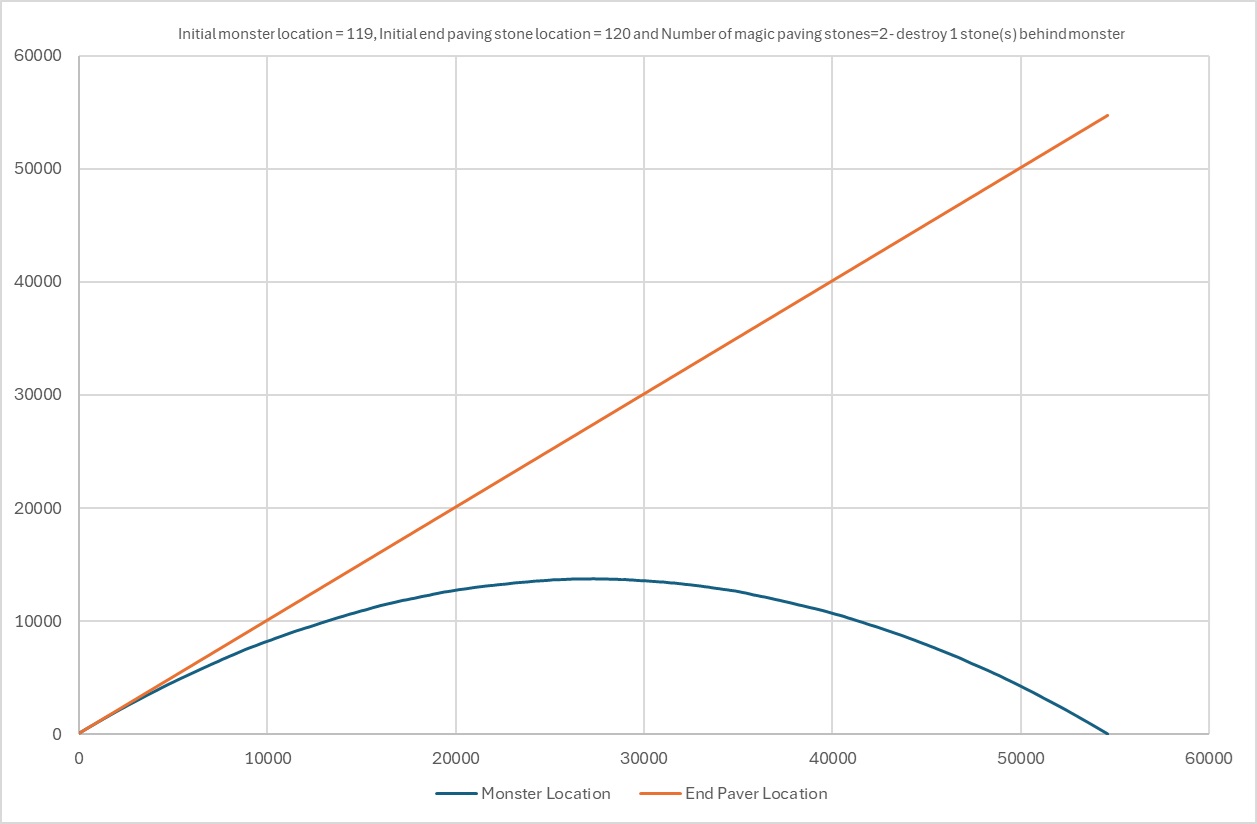
At the end of Twisting on the Magic Paving Stones, I noted that there was something unexpected.  Please look back over previous articles to see the full details but, in short, what I was discussing is a scenario in which, in each round of a sort of game, a number of magic paving stones (2) are inserted at random locations (with an evenly distributed likelihood) into a path, then a monster takes a step from one paving stone to the adjacent one closer to you (starting at one step closer to you than the last paving stone in the path) and then you eliminate one paving stone of your choice (and since you don’t want the monster to get you, you are going to eliminate one behind it, further away from you).

Set the number of randomly inserted paving stones to 2, the initial pathlength to a sufficiently large value (for which I choose 120, so the monster starts on paving stone number 119) and plot the output once every 200 rounds and you get this:

It might not be immediately obvious, but we’ve seen something like this before (or at least those of us who looked at the OE curve).  To emphasise this, here is that monster location curve with the OE curve below it – noting that smoothing has been turned off.

This is rather curious and was in fact something that I was struggling with – having previously posted two articles on the same sort of thing before retracting them (soon to be reinstated at Observable Events Curve - Is Double Dipping Essential? and Observable Events Curve - Not Quite a Drunkard's Walk).

Note that the time (or number of rounds) that is taken for the monster to get you (or “capture time”) is not set, there’s something akin to chaos happening in that the capture time very much depends on slightly different conditions early in the scenario, which – after the first round – are randomly imposed.

The OE Curve line in red above is based on time it takes for the separation to reach zero, t0 (with a relatively insignificant offset to account for the fact that the initial separation is not zero, but rather an offset that we can call xi).  The final equation becomes:

x'=ct((ct0+xi)-ct)/(ct0+xi)

If ct0>>xi and ct=x, this approximates, of course, x'=x(ct0-x)/ct0.